The Future of Cooling in UK Buildings

May 2026
The Climate Change Committee (CCC) recently published a report titled “A Well-Adapted UK” [1], highlighting the importance of preparing the built environment for warmer conditions and reducing the risks associated with overheating. The UK’s changing climate is no longer a future concern, but a growing reality that is already impacting the way we live, work and design our buildings.
WHAT IS OVERHEATING?
CIBSE considers overheating to occur when internal conditions exceed acceptable thermal comfort limits for occupants [2]. It is a major concern as overheating not only causes occupant discomfort, but can also negatively impact health, wellbeing, and productivity [3].
Furthermore, CIBSE states that there is a significant danger of heat stress if the internal temperature is above 35°C. In extreme cases, this can cause fatalities.
Last year (2025) was the UK’s hottest year on record, with some parts of the country reaching outdoor temperatures of 35.8°C [4]. As heatwaves become more frequent and intense, overheating in buildings is becoming an increasingly important consideration for developers, consultants and building owners alike.
At the same time, the introduction of the Future Homes Standard and evolving building regulations are placing greater emphasis on creating homes and commercial spaces that are highly energy efficient and designed to minimise heat loss. These improvements are helping accelerate the adoption of low-carbon heating systems such as heat pumps, which operate most effectively at low water temperatures and play a vital role in the transition towards net zero.
However, while reducing operational carbon remains a key priority, there is also a growing need to ensure indoor environments remain comfortable not only during winter, but increasingly during warmer summer periods too. This presents an opportunity for the industry to rethink how buildings are heated and cooled.
BRIZA: SMART COOLING TECHNOLOGY FOR HEAT PUMP SYSTEMS
Traditionally, homes in the UK have relied on passive methods to stay cool during warmer weather, including opening windows, using blinds or curtains to reduce solar gain, planting trees for natural shading, or introducing portable fans to improve air movement indoors.
While these approaches still play an important role in reducing overheating, they are becoming less effective on their own as UK summers become warmer and heatwaves more prolonged. In highly insulated and airtight buildings, particularly those designed to meet Future Homes Standard requirements, excess heat can become trapped indoors for longer periods, making it increasingly difficult to maintain comfortable internal temperatures through passive measures alone.
As a result, many homeowners, developers and specifiers are beginning to consider active cooling solutions as part of future-ready building design.
Traditional air conditioning systems can provide rapid cooling performance, but they often come with higher energy consumption, increased operational carbon emissions and visually intrusive wall-mounted units. For projects focused on sustainability, energy efficiency and low-carbon operation, this presents a challenge: how can buildings remain comfortable in summer without undermining wider decarbonisation goals?
This is where solutions such as Jaga’s Briza range offer a more balanced approach.
Designed specifically to complement low-temperature heating systems such as heat pumps, Briza units incorporate Jaga’s Low-H2O heat exchanger technology to deliver efficient heating and cooling from a single compact solution. By enabling heat pumps to operate at lower flow temperatures and optimised performance levels, Briza helps maximise overall system efficiency while providing sustainable, energy-efficient comfort all year round.
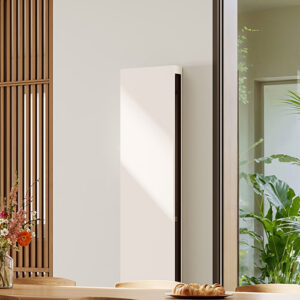
Available in a wide range of wall-mounted, recessed and ceiling-mounted configurations, Briza units can be integrated discreetly into almost any environment, combining high performance with the flexibility to complement a variety of interior styles
Briza also offers a future-proof solution for both new-build and retrofit projects as heat pumps can be introduced later without the need to replace the emitter, helping support the long-term transition towards lower-carbon buildings.
By combining sustainable cooling, efficient heating and heat pump compatibility within a single solution, systems such as Briza are helping redefine how buildings can remain comfortable, resilient and energy efficient in a changing climate.
DISCOVER MORE
- CCC (2026) A Well-Adapted UK. Avaiable at: https://www.theccc.org.uk/publication/a-well-adapted-uk/
- CIBSE (2020) Overheating Position Statement. Available at: https://www.cibse.org/policy-advocacy/key-policy-areas/health-and-wellbeing/overheating-position-statement/
- CCC (2022) Risks to health, wellbeing and productivity from overheating in buildings. Available at: https://www.theccc.org.uk/publication/risks-to-health-wellbeing-and-productivity-from-overheating-in-buildings/
- Met Office (2026) 2025 is double-record breaker: UK’s warmest and sunniest year on record. Available at: https://bit.ly/49a3jOD
- GOV.UK (2026) The Future Homes and Buildings Standards: Building Circular 01/2026 – letter. Available at: https://bit.ly/4v11LPd
- Jaga (2022) Tackling Overheating in Modern Buildings. Available at: https://dev.jaga.com/uk/tackling-overheating-in-modern-buildings/
- Jaga’s Briza range. Available at: https://dev.jaga.com/uk/briza/
- Jaga’s Low-H2O technology. Available at: https://dev.jaga.com/uk/jaga-low-h2o/