KEY HEATING CONSIDERATIONS FOR CARE HOMES AND RETIREMENT LIVING

May 2017
One of the most prominent – and unpredictable issues – is heating.
ENERGY USAGE
Because care homes are effectively 24/7 operations, energy usage is one of their greatest expenditures. Equally, with care homes and retirement living, occupants are likely to stay at home more and therefore have the heating on for longer as well as the communal spaces which need to be constantly heated. That said, there are heating options available that can help exceed residents’ expectations of their living environment whilst freeing up greater financial resources for the operators or property owners.
Money saved is money that can be reallocated towards improving the overall quality of day-to-day life.
CARE HOMES: RISING IN AGE, RISE IN COSTS
A report by Age UK estimates that there are 426,000 elderly and disabled people in 5,153 nursing homes and 12,525 residential homes. In the coming years, that figure is expected to rise significantly. Alarmingly, that rise coincides with energy experts’ predictions that energy bills will double in the next 10 years, after they went up 151% between 2004-2012.
But how can we cut costs to meet these challenges without compromising on the quality of overall care? The answer may well lie in the systems that care homes and retirement homes use to heat their buildings.
RETIREMENT VILLAGES: MEETING GROWING DEMAND
According to the Office of National Statistics (ONS), in 2016 more than 1.6 million people were aged 85 or over in the UK. By 2041, the ONS predicts that this will double to 3.2 million.
It’s estimated that around 25,000 older people currently live in retirement villages in this country, and the above figures show that’s only expected to grow. With more homes being built, the onus on developers to look at energy efficient heating solutions grows.
LOW-ENERGY SOLUTION
There are measures available that are cost-efficient both in their implementation and their overall running costs. Care home operators and retirement village developers should look for Low-H2O radiators that contain 90% less water than that of a steel panel to produce the same amount of heat, which will in turn provide energy savings of up to 15%. For retirement living, this is also a critical factor as affordable warmth is important because occupants pay their own energy bills.
The scale of these savings is considerable, with substantial savings year on year. Not only that, the living environment will become safer and more comfortable for residents.
CARE HOMES: THE SAFETY FACTOR
Especially important in care homes due to the vulnerability of residents, is choosing a safe to touch design. For social care operators, there is a responsibility to ensure that residents are protected from the risks associated with radiators and their pipework, such as scalding or injury caused by sharp edges.
Jaga low surface temperature (LST) radiators such as the Maxi 2020 LST feature a strong, robust casing , eliminating the chance of burns. This casing also has rounded corners and edges to minimise the risk of injury if anyone fell against the radiator.
RETIREMENT VILLAGES: AESTHETIC DESIGN
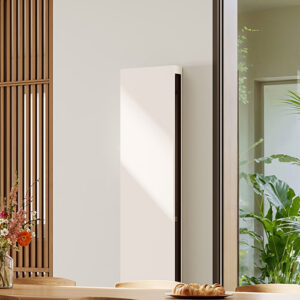
More so a factor for retirement villages, is the aesthetics of the radiator. As residents are paying for the independence of living in their own house or apartment, the overall look of the radiator is a key consideration. Jaga’s Strada radiators for instance, have a contemporary yet timeless, slim-line design which also ensures that they do not overly intrude into the living space.
Spiralling energy costs is a serious issue, but resolving it can be straightforward. Care home operators and retirement village developers are in the position to prepare their buildings to provide a future-proofed and more cost-effective quality of care.